

Farm Bureau: Regenerative ag acres grow 5x over last decade
Across America’s breadbasket and throughout the prairies, forestlands, croplands and orchards, regenerative agriculture practices are woven into the landscape.





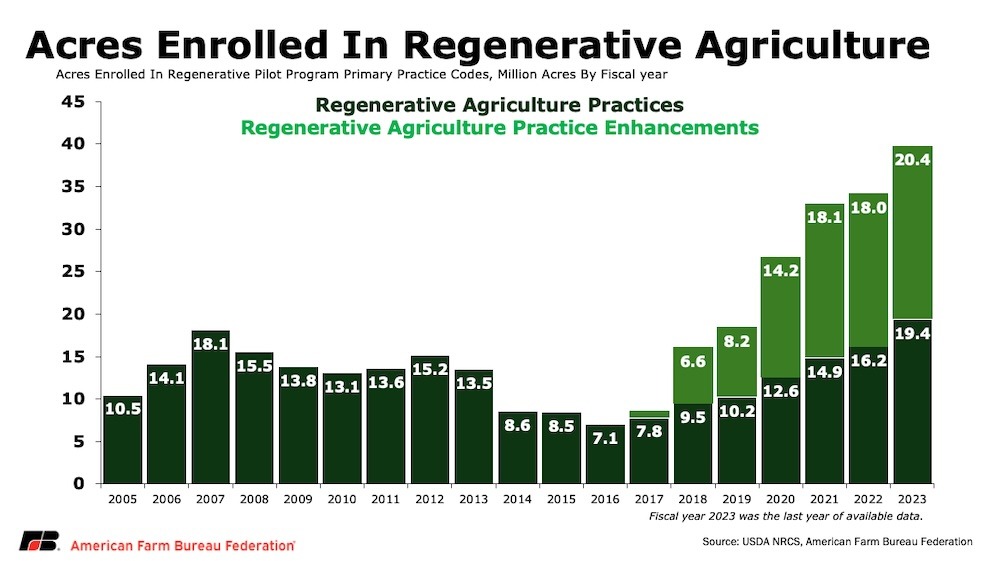
American Farm Bureau Federation (AFBF) vp of public policy and economic analysis John Newton just released a new analysis showing U.S. active farm acres that feature regenerative agriculture practices have increased from 8 million in 2014 to just under 40 million by 2023, an impressive 360% increase across just nine growing seasons.
The data Newton cites was culled directly from USDA’s Soil and Water Resources Conservation Act conservation program reports.

While the bulk of the reported acres — nearly 19% — featured rotational livestock grazing practices as the most common regenerative farming practice, there were also several regenerative farming practices that specialty crop growers would easily recognize, among them:
- Pest management conservation systems (6%)
- Nutrient management (4%)
- Cover cropping systems (3%)
- Reduced and no-tillage farming systems (3%)
- Irrigation management (less than 1%)
Newton writes the data shows that farmers and ranchers are America’s original conservationists.
While the focus of this analysis is the adoption of regenerative agriculture practices through USDA’s financial and technical assistance efforts, it is important to acknowledge that many farmers adopt and continue to utilize voluntary conservation practices outside of the traditional USDA-funded efforts. Farmers and ranchers also participate in state-level initiatives and initiatives with private sector partners. Some fund their own efforts.
When including all USDA-funded conservation efforts such as the Conservation Reserve Program, the Agricultural Conservation Easement Program and the Regional Conservation Partnership Program, among others, in fiscal year 2023 alone farmers, ranchers and conservationists had deployed an approved conservation practice on nearly 70 million acres of activity.
Across America’s breadbasket and throughout the prairies, forestlands, croplands and orchards, regenerative agriculture practices are woven into the landscape. Farmers have been integrating these practices for decades to find what works best for their farms. Because these practices are not one-size-fits-all, regenerative and traditional practices can go hand-in-hand on a journey of continuous improvement.
Farm Bureau recognizes regenerative agriculture as any production system that minimizes environmental impacts, maximizes production, promotes stewardship, and increases economic viability and the productivity of soil over time. Importantly, Farm Bureau supports voluntary regenerative agriculture initiatives – conservation efforts that have long been a fixture of American agriculture. We recognize that every farm is different, and that making any change on the farm takes careful planning and comes with extra expense. Every farmer should have the opportunity to make the changes that work best for their farm, without placing their farm’s economic sustainability at risk.
-John Newton, AFBF