






Feb 16, 2023
Fall foragers: Mustard cover crops provide biofumigation
Growing mustard cover crops for biofumigation is an emerging strategy that can help manage many soil pathogens. In Ohio, growers can use mustard cover crops in spring to help control Plectosporium before planting pumpkins, reducing the reliance on conventional fungicides.
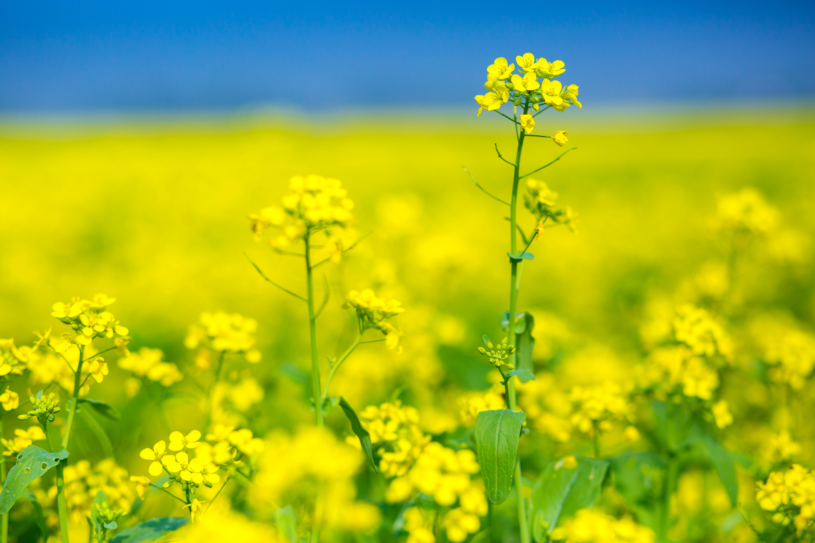
Now, new research from Ohio State University shows seeding a mustard cover crop after wheat harvest offers another biofumigation window — and provides an excellent source of pollen in the fall for honeybees.
“The window for biofumigation can get narrow in the spring,” said Jim Jasinski, integrated pest management program coordinator with the OSU Extension. “If you’re planning on planting pumpkins in late May or early June, you’re talking about an April planting of a mustard cover crop. But when you put mustard in after wheat, you can get two to three months of good growth.”
Supporting pollinators in the fall
Pollinator benefits are an added bonus. Research by Chia-Hua Lin, a research scientist in OSU’s Department of Entomology, placed honeybee hives near spring and fall mustard cover crops to analyze the pollen collected by the bees.
In the spring, 89% of the pollen collected by the honeybees came from clovers, more specifically the Trifolium genus of the Fabaceae family of plants (red clover is Trifolium pratense; white clover is Trifolium repens). Very little pollen was collected from the Brassica family, which includes mustard.
In the fall, when vegetation is senescing, the percentages reversed, as 77% of the pollen came from Brassicas — primarily the late-planted mustard cover crop.
“The bees will forage where there is pollen,” Jasinski said.
Dual-season disease management
A fall biofumigation cycle can also reduce disease pressure for the following spring. Spring weather can limit cover crop establishment.
“A fall cover crop gives you one shot to knock down the level of Plectosporium inoculum in the soil,” Jasinski said. “The cover crop the next spring gives you another shot to knock it down even more.”
Plant material from the mustard cover crop that overwinters will not sustain Plectosporium since the cucurbit pathogen isn’t known to survive on Brassica crops. Glucosinolates are the compounds in the mustard plant tissue responsible for the biofumigation effect. They are released when the mustard plant tissue is finely chopped and incorporated into the soil. Through various chemical reactions, the glucosinolates break down into allyl isothiocyanate, which is one of the key compounds with fumigation properties.
Mustard cultivars and incorporation timing
OSU researchers worked with the mustard cultivars Pacific Gold, Caliente 199 and Caliente Rojo. These are brown mustards that contain the highest concentrations of glucosinolates.
The amount of glucosinolates in the mustard biomass increases until peak bloom. The cover crop is then cut or mowed, immediately incorporated, packed and the soil sealed with water.
A flail mower is the best for cutting, though a Bush Hog is more commonly used. Growers typically rototill, then cultipack to retain gases in the soil.
“Sealing is the most difficult step,” Jasinski said. “There’s not an easy way to apply irrigation, especially to a large field.”
The moisture acts as a sealant, much like the tarping used in soil fumigation.
Irrigation is effective but requires lots of water. A simpler approach is to try to incorporate and pack before a rain.
OSU researchers went slowly over their plots with a sprayer. Sometimes the best you can do is cut, incorporate, pack and hope for the best.
Timeliness is key
Timeliness of operations is essential. You want to mow, incorporate and pack within minutes of each other. Many farms use multiple tractors and operators to maintain that pace.
After spring incorporation, Jasinski recommends waiting 7 to 10 days before transplanting and 10 to 14 days before direct seeding to allow the biofumigation process to finish. Waiting also helps avoid seedcorn maggot, which is drawn to green plant material.
“You want the biofumigation process to run its course,” Jasinski said. “I wouldn’t push the envelope too much.”
Fertility, biomass and rotation
The key is to fertilize the mustard. A higher fertility means more biomass which means glucosinolate. Fifty to 75 pounds of actual nitrogen per acre is the standard recommendation.
“More biomass means more biofumigation power,” Jasinski said.
Timely termination at peak bloom is essential — especially in the fall — or you may get seed set and volunteer mustard the next spring.
Biofumigation must still be combined with a good rotation. The general recommendation for fields infested with Plectosporium is to plant cucurbits once every three to five years.
Plectosporium does not infest every field, and inoculum levels do vary. Weather affects the infection rate, and there may be very little Plectosporium observed in a dry year.
Pumpkin varieties vary in their susceptibility to Plectosporium, although most hybrids are susceptible. True squashes, C. maximus and other species, tend to be less susceptible.
“There are a lot of variables with this disease, so it’s hard to tell how successful you’re going to be with biofumigation until you try it on your farm,” Jasinski said.
Next steps: measuring soil health benefits
One unanswered question with the practice is the benefits of the organic matter the mustard cover crops add to the soil. That is the next research focus at OSU.
“We’re interested to determine the net soil health effect of turning above-ground mustard biomass back into the soil,” Jasinski said.
Potential benefits include reduced disease pressure, improved soil structure, greater nutrient availability, increased water-holding capacity and overall better soil health — all aligning with the goals of sustainable and organic farming systems.