






Dec 5, 2025
Mechanical advances help target weeds on organic vegetable farms
Weed control in organic agriculture comes in many forms, from physical methods and flame weeding to biological approaches such as cover cropping and crowding planting.
Full Hollow Farm in Belding, Michigan, has experience with all of the above but has made the biggest strides through mechanical weeding strategies, suppressing weeds naturally and sustainably.
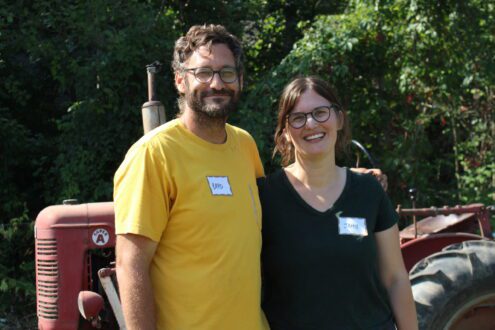
Jamie Wilbraham and Brad Smith grow certified organic vegetables on the farm they have owned for 11 years. Both had experience on farms of various sizes before teaming up for their “fairly small-scale” direct-to-consumer operation, which has five full-time employees and one part-timer, Smith said.
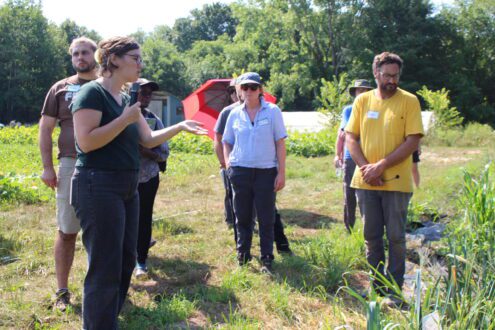
“We grow on about four acres,” Smith told an audience at the Aug. 7 Organic Weed Management Field Day, sponsored by Michigan State University Extension. “It’s plenty of work for us and our crew, but in the grand scheme, we’re a tiny operation.
Mechanized farming experience
The two worked at several farms, including urban farms in Pittsburgh. They were also employed together at a large organic farm outside of Pittsburgh, which was in business for more than 30 years.
“It had a crew of five or six people, growing 30 acres of vegetables,” Smith said. “It was very mechanized and really had it down. We’ve had a lot of different experiences. We were able to take things from each place and decide what we liked and what we didn’t.”
When starting their own farm, the couple realized that they “needed to do some type of mechanical cultivation so that we weren’t hand-weeding everything,” Smith said.
Reducing hand weeding
“We had a wheel hoe that really helped, but now I can have a crew hoe a section, and if it’s one bed it will take them a half hour if we haven’t done anything to it,” Wilbraham said. “Whereas, I can go through with a tractor and get maybe 95% of the weeds, and it might take me a minute or something.”
The couple wanted to invest in tools “so that labor hours can go to things that tools can’t do,” Wilbraham said. “Brad is interested in and really loves the mechanical part. Every farm is different in what you enjoy and chase. It’s good to have many different options in your weed management tools.”
Overcoming financial barriers
Smith acknowledged that finances are the biggest barrier.
“It’s definitely been a process. It’s not like, ‘Let’s go out and buy this thing we know we want.’ It’s been done in stages,” he said.
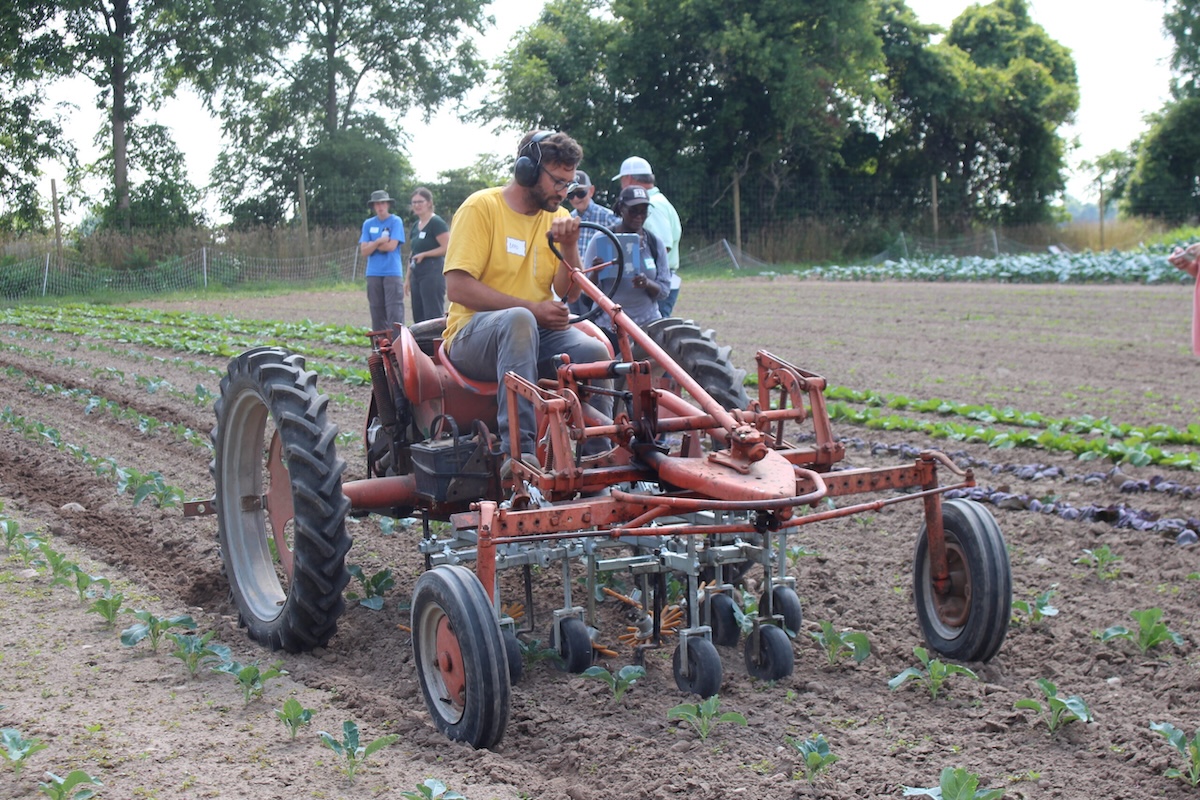
The couple purchased two older tractors, and Smith’s previous experience operating an old cultivating tractor has paid dividends. The farm now uses a tine weeder, a basket weeder that goes in between the rows and a finger weeder, allowing them to avoid applying organic herbicides.
Tools and crop spacing
The farm follows specific spacing for different crops, with tools always set up for one-, two- or three-row spacings.
“We don’t move things too much,” Smith said. “It’s more of an issue when I’m doing a three-row crop. I have all these spaces in between the tools where the crop is going to be. If I switch to doing a one-row crop, there is a little bit of adjusting I need to do, but it’s not that involved. Usually, it’s just loosening a couple of things and moving it around.”
Older tractors were designed so the operator could see the tools they are using, which Smith sees as a big advantage.
“You can see the tool you’re using, versus being on a three-point (tractor), where you aren’t looking down. The engine is offset, so you can see underneath. With one of our tractors, the engine is actually behind, so you have a view of everything.”
Weeding carrots and lettuce
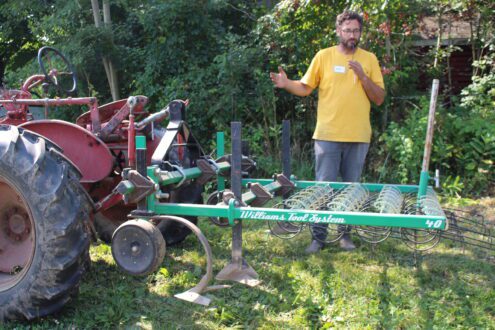
The farm employs two different tools on a 1940s-era McCormick Farmall, including a basket weeder used for small crops like carrots and salad mix.
“It doesn’t work as well for brassicas because sometimes they like to lean a lot,” Smith said. “They get in the way and can get picked up and uprooted by this (basket) tool.
“It is a very gentle tool in the grand scheme of things because it doesn’t throw a lot of dirt into the row. As crops get bigger, it isn’t helpful. This is nice for doing carrots when they emerge and are small and could get buried easily. If you’re planting everything very precisely, you could drive this really close on the inside of the row, turn around and drive really close on the other side.”
Small weed success
Smith has the Fillmore basket weeder set up so the company “can tell you the row spacing and what size baskets to get. It really works on small weeds but not anything big.”
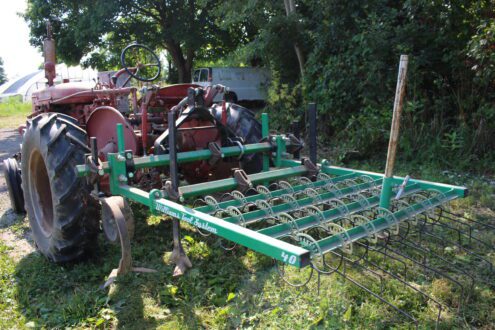
A Williams Tool System from Market Farm Implement tine weeder is attached to the back of the tractor.
“It can go in between a two-row crop,” Smith said. “It does give you a lot of options. If you have some bigger weeds the basket weeder wouldn’t take out, you can set this up so it can help take care of those other ones.”
The couple’s main philosophy is taking advantage of multiple types of tools in one pass.
“If the crop is too big, I won’t use the tines as it will damage the crop,” Smith said. “If my crop is three-row and I’m worried about the damage a tine can cause due to the crop, I can just set the ones down that are in between it. A lot of times, I’ll do all of the tines down to a certain setting. It actually weeds in the row, too.”
Ease of use and additional tools
With two cultivating tractors, Smith said they don’t require adding and removing components.
“They’re just set up so when you need them, they’re ready to go,” he said. “You might have to do a couple of little adjustments. That’s something for which there is a learning curve.”
Smith displayed the impact of his finger weeder, specifically designed for in-row cultivation, uprooting small and just emerging weeds. The ground-engaging steel drive plate turns the flexible polyurethane fingers at a faster speed to “flick” out emerging weeds at the hair stage.
“Overall, the finger weeder is a little more versatile, depending on how you’re planting things,” Smith said.
The farm is still pursuing other sustainable options.
“We use weed barriers and plastic to keep the weeds down,” Wilbraham said. “We also use cover-cropping in different ways. We’ve experimented enough to where we’ve chased that to do it a lot better.”