

Triple Helix calls for greater focus on specialty crop innovation





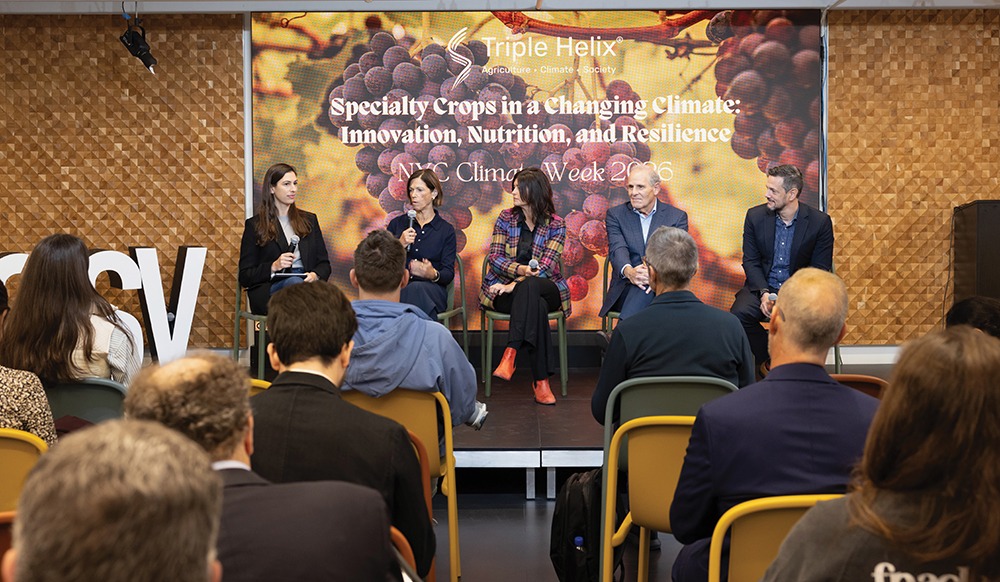
Specialty crops deserve a larger role in conversations surrounding climate resilience and agricultural technology, Triple Helix Institute for Agriculture, Climate and Society founder and executive director Sarah Garland said.
Triple Helix highlighted that need during “Specialty Crops in a Changing Climate: Innovation, Nutrition & Resilience,” a panel Garland hosted during Climate Week NYC in September.
“We really wanted to bring more emphasis onto specialty crops, which are really under-discussed in the climate conversation,”particularly considering their importance to nutritious and healthy diets, Garland said
The panel featured Vonnie Estes, International Fresh Produce Association vice president of innovation; Okanagan Specialty Fruits vice president of business development Sarah Evanega; and Heritable Agriculture CEO and co-founder Brad Zamft.
Garland said specialty crops have historically received less research attention than other commodities. Increasing awareness of their importance and opportunities for technological advancement could help attract additional resources.
Changing climate conditions are also creating challenges beyond heat and drought, she said
“As climate conditions change, the geographies and the life cycles of pests and diseases also change,” Garland said. Providing rapid-response, safe and sustainable solutions to those pressures “would be transformational” for specialty crop growers.
Triple Helix is a nonprofit focused on building cross-sector engagement and public understanding around agricultural technology. Rather than developing technologies itself, the organization connects stakeholders across research, industry, policy and communication.
“We’re kind of the connective glue,” Garland said.
Garland earned her doctorate in plant sciences from the University of Cambridge, where her research focused on CRISPR gene editing in plants. Her later work at Columbia University explored crop biotechnology’s role in nutritious and climate-resilient agricultural systems.
For Garland, connecting researchers with the growers who will ultimately use new technology is critical.
“There’s lots of great research going on in academia. There’s work going on, obviously, in government research labs,” she said. But she said greater alignment with growers and grower associations can help ensure innovations solve real problems and are readily adopted.
The Climate Week program also honored Nick Dokoozlian, vice president of grape, wine and beverage research at Gallo, with the inaugural Triple Helix AgTech Leadership Prize.
The award recognizes leaders who work across disciplines and sectors to advance agricultural innovation.
Dokoozlian’s career includes helping form the National Grape Research Alliance and establishing the GRAPEX project, a collaboration involving Gallo, USDA Agricultural Research Service, NASA, Utah State University and others that helped reduce vineyard water use and expanded into other specialty crops.
Garland said his work in grape innovation provides a model for other commodities.
The broader goal is to ensure specialty crop growers can continue producing the foods consumers depend on while adapting to mounting challenges.
“My vision is that all of these different crops will be thriving, that we can increase the diversity of our crops and therefore the nutritional options available and affordable for consumers,” Garland said. “We need to make sure that it is still … a viable thing to be growing these crops that all of us really depend on.”