

Fresh perspective, deep roots





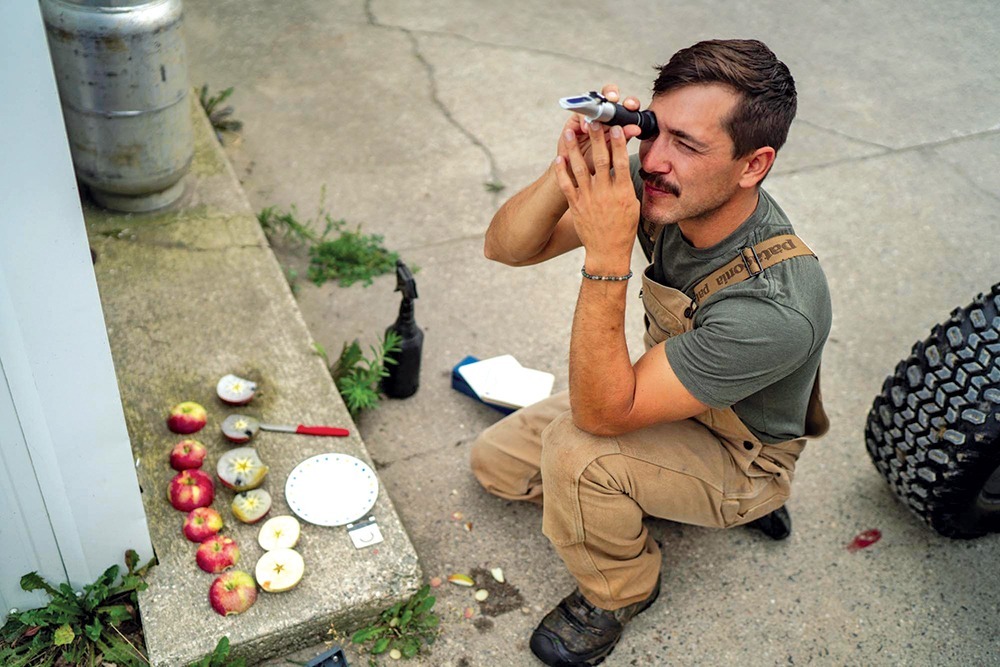
Incoming MSHS president Kyle Rasch aims to grow opportunities for the next generation
For Kyle Rasch, the path to leading the Michigan State Horticultural Society began thousands of miles from his family’s apple orchard in Greenville, Michigan.
After growing up working on the family’s farm, Rasch spent much of his 20s traveling the world, learning about organic agriculture and exploring different approaches to farming. Those experiences eventually brought him back to Michigan, where he helped transform his family’s conventional apple operation into a regenerative organic orchard.
Now, as incoming president of the Michigan State Horticultural Society for 2027, Rasch hopes to use that experience to help Michigan growers navigate industry challenges, strengthen research opportunities and build a more sustainable future for family farms.
“I think it’s really listening, connecting Michigan agriculture back to customers as well, and making sure that we can create more dialogue between the agriculture and the end consumer,” Rasch said.

Three generations of growing
Rasch represents the third generation of his family to operate what is now known as Third Leaf Farm.
His grandfather, Tom Rasch Sr., established the operation in the early 1960s as a diversified farm producing fruits and vegetables for specialty markets. Over the years, the farm also offered U-pick opportunities before his father, Tom Rasch Jr., shifted the business toward commercial apple production.
At its peak, the family grew approximately 180 acres of apples.
When Rasch began returning to the farm about 15 years ago, he brought ideas that would eventually reshape the operation.
Encouraged by his father to explore opportunities outside agriculture, Rasch studied business and marketing before spending much of a decade traveling and working on organic farms through Worldwide Opportunities on Organic Farms, an international agricultural work-exchange program.
His travels took him to Australia, India, Nepal, Europe and South America, where he gained experience with agricultural systems that emphasized working with natural processes.
“It very much felt like a partnership and collaboration with nature,” Rasch said.
Rather than viewing every pest or disease as an isolated problem, he became interested in understanding the conditions contributing to those challenges.
When he returned to Michigan, Rasch began introducing organic practices to the family’s orchard, initially experimenting with a block of trees scheduled for removal.
The results encouraged the family to continue transitioning approximately 10% of its acreage annually.
Today, Third Leaf Farm operates about 100 acres of organic apples and has achieved Regenerative Organic Certified status across the farm.
The operation has also diversified its marketing, developing relationships with organic processors while expanding fresh market, wholesale and direct-to-consumer sales.
Combining tradition with technology
Although the farm’s production practices emphasize soil health and biodiversity, Rasch said the operation relies heavily on modern research and technology.
The family conducts extensive soil testing, evaluates fruit nutritional composition and is exploring the use of drones, artificial intelligence and robotics.
Rasch’s younger brother, Devin, who has a background in medicinal plant chemistry, helps design research trials, collect data and evaluate results. The farm also works with third-party laboratories and university researchers.
“We’re using that insight from traditional wisdom alongside all of the new science and techniques and technology that’s available,” Rasch said.
One ongoing research partnership with Michigan State University and Penn State examines how different orchard floor management practices affect soil health, tree nutrition and fruit quality.
The multiyear trials compare organic herbicide treatments with wood chip mulch, diverse ground covers, wildflowers and combinations of those practices in established and newly planted orchards.
Researchers are measuring changes in soil nutrients, leaf nutrition and fruit composition to better understand how orchard management influences the entire production system.
Rasch said the farm also works with agricultural product companies and other growers to evaluate practices that could improve production in the Midwest’s humid climate, where pest and disease pressure presents ongoing challenges.
The goal is not simply to improve Third Leaf Farm’s operation, but to develop practical information that other growers can use.
“We’re trying to be an open book,” Rasch said. “Share what’s working, what’s not working, and try to capture as much data along the way.”
Supporting Michigan growers
Rasch’s involvement with the Michigan State Horticultural Society began when neighboring grower Chris Croft recommended him for a position on the organization’s board.
Initially interested in ensuring organic growers had a voice, Rasch quickly developed a broader appreciation for the organization’s role in supporting Michigan horticulture.
He began serving on the research committee and later joined the committee responsible for the Great Lakes Fruit, Vegetable & Farm Market EXPO.
Those experiences provided insight into the research, education and industry partnerships needed to support growers throughout the state.
“I know what it takes to farm in Michigan, and farming in general is quite a challenging environment at the moment,” Rasch said.
With profitability pressures mounting and smaller operations struggling to compete, Rasch sees the state horticultural society as an important resource for connecting growers with opportunities.
As president, he plans to focus on strengthening research, expanding industry collaboration and helping growers identify new markets and production practices.
He also hopes to build on partnerships that make regenerative agricultural practices more accessible to both organic and conventional operations.
Another priority is ensuring that Michigan State University has the research and Extension resources needed to address emerging production challenges.
Rasch said the Great Lakes EXPO will remain central to those efforts.
He hopes to continue strengthening the event as a place where growers, researchers, suppliers and buyers can exchange ideas and develop relationships.
His broader goal is to help Michigan’s horticultural industry remain competitive in domestic and international markets while creating opportunities for the next generation.
Creating value beyond the orchard
At Third Leaf Farm, Rasch and his family are exploring ways to differentiate their apples from larger commodity markets by emphasizing flavor, quality and production practices.
He believes creating more value for consumers could provide additional opportunities for smaller family farms that struggle to compete on volume and price alone.
The farm is also working to develop approaches other growers could adapt to strengthen their businesses.
Beyond production, Rasch wants to improve relationships throughout the supply chain, including communication between growers, buyers and larger companies.
He believes those relationships should better recognize the financial pressures producers face.
Another long-term priority is addressing the demanding workloads that often accompany farming.
Rasch said developing better management systems, using technology and improving staffing could help growers achieve a more sustainable balance between their businesses and personal lives.
“One hundred hour-weeks are not the most sustainable thing,” Rasch said.
He acknowledges that the farm is still working toward those goals, but believes improving quality of life is essential to keeping future generations involved in agriculture.
Building on a family legacy
Despite the changes at Third Leaf Farm, Rasch credits the operation’s progress to the people who have helped make it possible.
His father continues to play an important role in the business, while his brothers contribute specialized expertise. Devin supports the farm’s research efforts, and his brother Eric manages beekeeping activities.
Rasch also credits the farm’s full-time employees and H-2A agricultural workers for supporting the operation’s continued growth.
He said one of the most meaningful developments has been watching his father embrace changes to the business after decades of conventional production.
For Rasch, that willingness to adapt reflects the same mindset he hopes to encourage throughout Michigan’s horticultural industry.
His grandfather, who founded the farm more than six decades ago, died earlier this year, leaving a legacy the family continues to build upon.
As Rasch prepares to assume the society’s presidency, he hopes to honor both his family’s history and the generations of industry leaders who helped establish Michigan’s horticultural community.
His focus remains on creating opportunities that allow growers to adapt, remain profitable and continue farming for generations to come.